Eyewear Empire Economics
Why does a standard pair of prescription glasses—essentially a couple of ounces of molded plastic and two small glass lenses—cost upwards of $200 or $300?
While it is tempting to blame the raw material cost or the high-tech machinery required for prescription lens grinding, the real answer lies in microeconomics, supply chain architecture, and market power. By examining the business model of global giant EssilorLuxottica, we can unpack how a single firm commands a multi-billion dollar empire by exploiting consumer elasticity, executing brilliant brand repositioning, and using vertical integration to lock down the market.
Throughout this case study, we apply economic frameworks to explain how EssilorLuxottica controls quantity, prices, and profits (Vlassis 2023a).
1. The Elasticity of Vision: Generic vs. Designer Markets
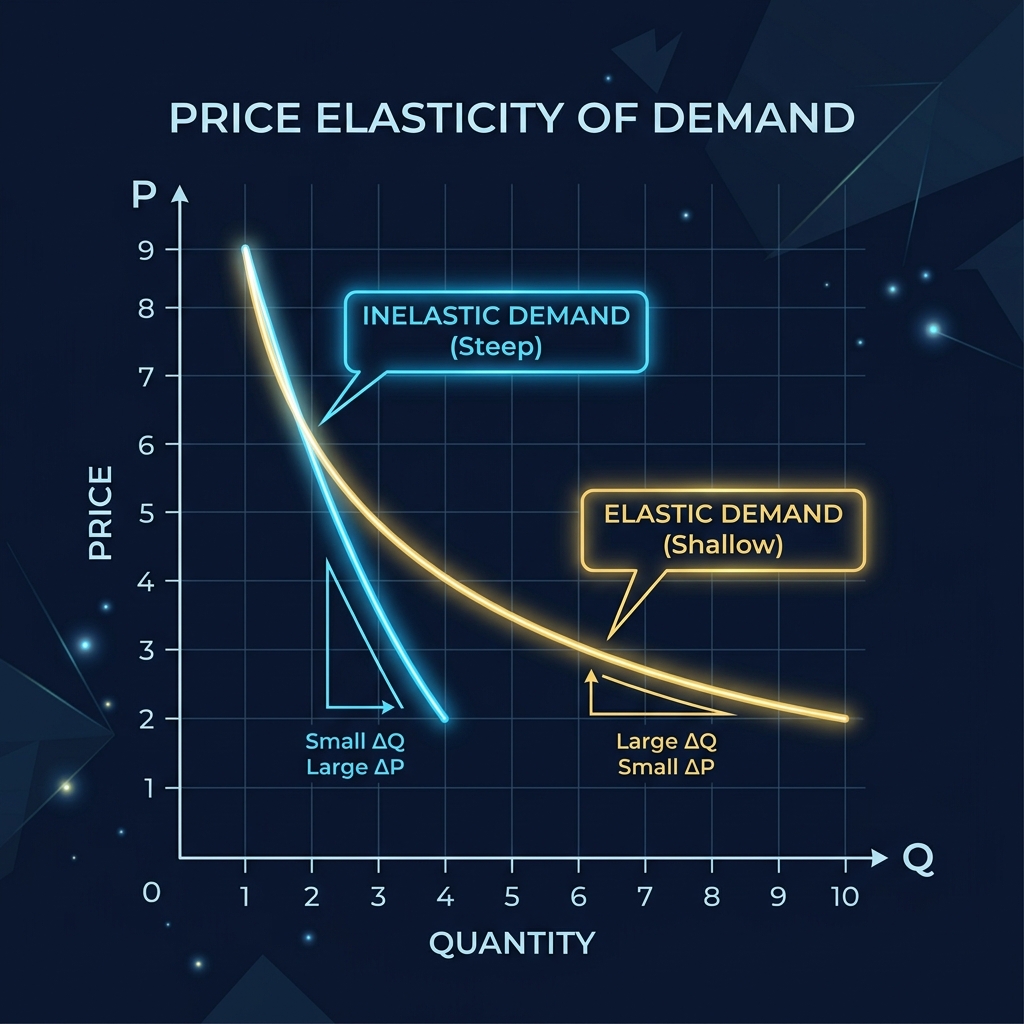
To understand eyewear pricing, we must first look at the price sensitivity of the consumers buying them. In economics, this is measured by the Price Elasticity of Demand (ε), which calculates how much the percentage change in quantity demanded (Q) responds to the percentage change in price (P) (Begg & Ward 2020):
Price Elasticity of Demand (ε) = % Change in Quantity Demanded / % Change in Price
In the eyewear market, demand splits into two completely different behaviors depending on whether the product is a medical necessity or a fashion luxury.
Generic/Necessity Eyewear (Prescription Glasses)
For millions of people, prescription spectacles are not a style choice; they are a prerequisite for a normal quality of life. Because there are no viable substitutes for vision correction, generic prescription glasses have highly inelastic demand (0 < |ε| < 1) (Goolsbee et al. 2020).
If the price of prescription lenses rises, consumers will still buy them because they simply have to see. This price-inelasticity gives sellers significant pricing power: raising prices leads to an increase in total revenue because the price gain outweighs the tiny drop in sales volume.
However, generic frames and off-the-shelf reading glasses are widely available. In economic terms, they behave like an inferior good—as consumer incomes rise, demand for them actually drops because buyers quickly switch to name-brand, custom-fitted frames (Begg & Ward 2020).
Designer/Luxury Eyewear (Fashion Brands & Sunglasses)
In contrast, designer sunglasses and high-end fashion frames are luxury goods. Under standard economic theory, luxuries are highly price-elastic because they are non-essential. However, strong brand equity and prestige (status signaling) can warp this relationship, making designer eyewear highly price-inelastic for targeted affluent niches (Vlassis 2023a).
Consumers are willing to pay massive markups for designer labels (e.g., Ray-Ban, Oakley, Chanel) because cheap, generic sunglasses are not perceived as close substitutes in terms of social cachet (Forbes 2023b). While contact lenses or laser eye surgery are substitutes, they remain imperfect due to cost, convenience, or physical suitability.
2. The Ray-Ban Illusion: Repositioning a Commodity
One of the most famous case studies in modern brand repositioning is Luxottica’s acquisition of Ray-Ban in 1999 (Forbes 2023b).
At the time of purchase, Ray-Ban was a struggling brand. Its sunglasses were sold in drugstores, gas stations, and low-end retailers for a commodity price of around $19. To extract maximum value, Luxottica executed a classic “focus” competitive strategy to alter the brand’s price elasticity (Porter 2004).
The Zero-Supply Strategy
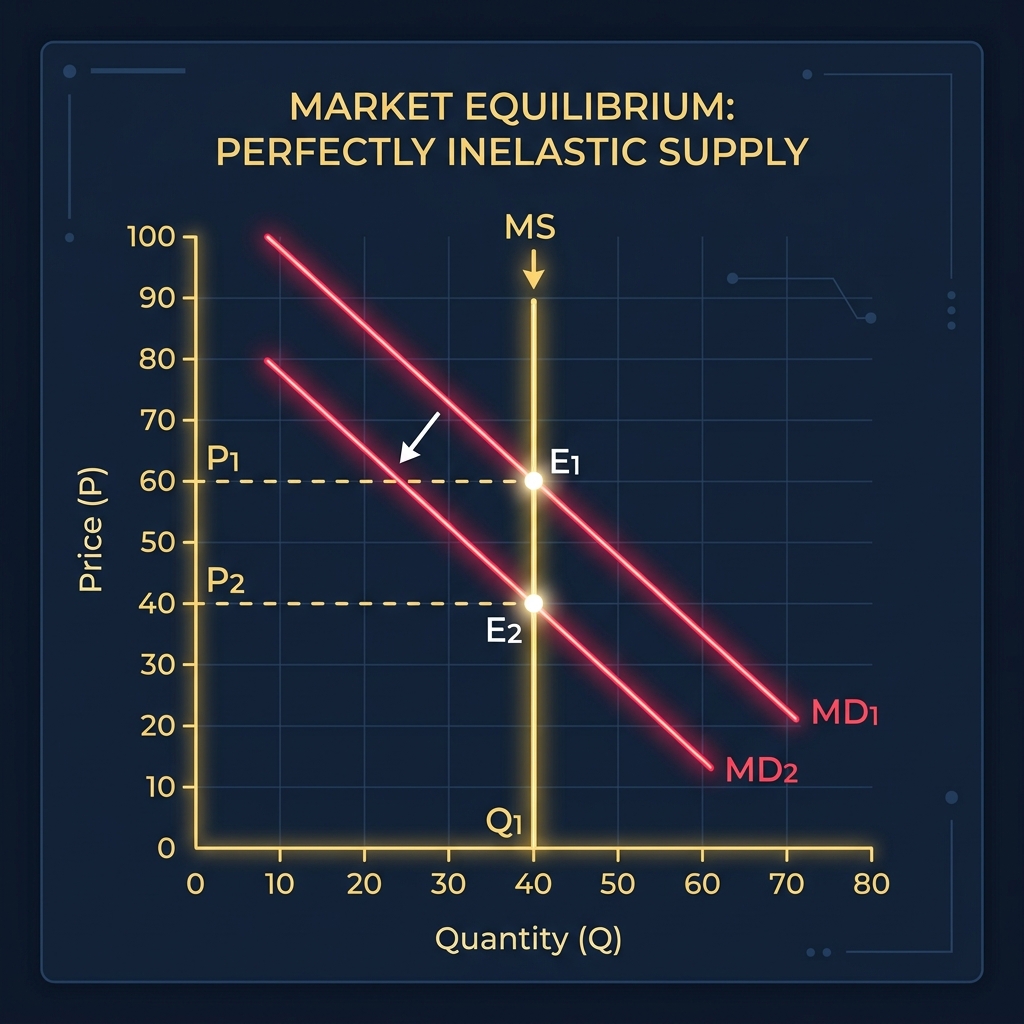
Rather than trying to gradually raise prices—which would have sparked consumer resistance—Luxottica temporarily set market supply to zero. They pulled Ray-Bans from 13,000 retail locations, making supply perfectly inelastic (a vertical supply curve) and allowing old inventory to clear.
This artificial shortage served two critical strategic purposes:
- Anchor Reset: It completely erased the consumer’s $19 price anchor from memory.
- Mitigated Multi-Pricing: It prevented the sunglasses from being sold at the old drugstore price and the new luxury price at the same time.
A year later, Ray-Ban was relaunched in premium department stores and specialized optical boutiques, priced at several times its original markup ($150+). By repositioning the brand from a normal/commodity good to a luxury fashion accessory, Luxottica shifted the target customer segment to less price-sensitive buyers, capturing the massive consumer surplus (the difference between what a consumer is willing to pay and what they actually pay) and turning it directly into monopoly profit (Goolsbee et al. 2020).
3. The Optics of Dominance: Vertical vs. Horizontal Integration
To maintain supernormal profits, a firm must establish high barriers to entry. EssilorLuxottica has built a near-impenetrable moat through aggressive horizontal and vertical growth (The Guardian 2023).
Double Marginalization & Vertical Integration
In microeconomics, Double Marginalization occurs when independent monopolies operate at successive stages of a supply chain. The component manufacturer adds a markup to sell to the assembler; the assembler adds their markup to sell to the distributor; the distributor adds another markup to sell to the consumer. This stacking of markups drives the final retail price up so high that overall market demand collapses, harming both consumers and the firms’ aggregate profits.
By vertically integrating, EssilorLuxottica solved this trap (Begg & Ward 2020; Porter 2004):
- Upstream: They produce the prescription lenses (Essilor).
- Midstream: They design and manufacture the frames (Luxottica’s portfolio).
- Downstream: They own the distribution channels (retail outlets like Sunglass Hut, LensCrafters, and Target Optical) and the vision insurance networks (EyeMed) that subsidize the purchases.
Integrating these stages eliminates double marginalization. The consolidated firm can control input costs for competitors, capture profits at every stage of the transaction, and optimize the total profit margin.
Horizontal Scale
At the same time, the company pursued a horizontal integration strategy, acquiring hundreds of competing frame makers, lens laboratories, and optical brands (The Guardian 2023). This consolidates their market share, generates massive economies of scale (reducing average cost per unit), and builds a massive intellectual property and licensing barrier that keeps new entrants out (Begg & Ward 2020).
4. The DTC Challenge: Monopolistic Competition in the Digital Age
Despite its massive scale, the traditional eyewear market behaves like monopolistic competition: a market with many competitors selling differentiated products, but with historically high barriers in physical retail distribution (Goolsbee et al. 2020).
In recent years, direct-to-consumer (DTC) online retailers like Warby Parker bypassed physical storefronts entirely.
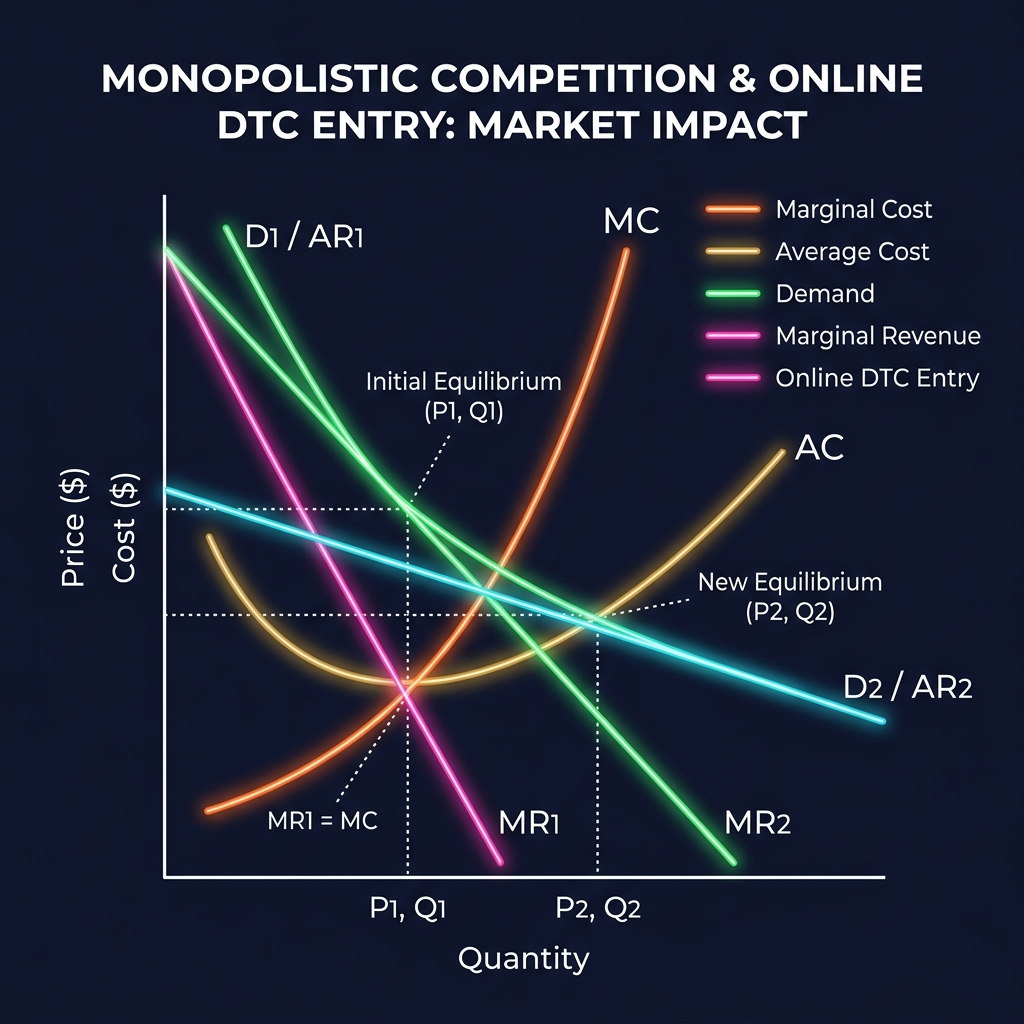
When online retailers entered:
- Shift in Residual Demand: The sudden availability of cheaper online alternatives shifted the traditional retail giant’s demand curve left (reduced market share) (Goolsbee et al. 2020).
- Increase in Elasticity: Because consumers had more choices, they became more price-sensitive. The residual demand curve became flatter (more elastic).
- Profit Compression: In the long run, entry of new competitors forces the price down until the demand curve becomes tangent to the Average Cost (AC) curve, compressing supernormal economic profits down to normal competitive returns (Goolsbee et al. 2020).
However, EssilorLuxottica’s vertical integration and control over the licensing of major fashion labels protect its high-end designer segment from being completely commoditized by online startups.
Conclusion: The Ultimate Extraction Engine
EssilorLuxottica’s dominance is not an accident; it is a textbook execution of microeconomic principles.
By operating a two-pronged strategy—cost leadership in the generic market through scale and vertical integration, and brand power in the luxury segment through licensing and scarcity control—they have built an incredibly efficient engine for extracting consumer surplus. While online retailers continue to chip away at the commodity end of the market, the vertical integration of lenses, frames, and insurance guarantees that the eyewear empire remains highly profitable for decades to come (The Guardian 2023; Forbes 2023a; Forbes 2023b).
References
- Begg, D. and Ward, D. (2020) Economics for Business. 6th ed. London: McGraw-Hill.
- Forbes (2023a) Meet the Four-Eyed, Eight-Tentacled Monopoly That is Making Your Glasses So Expensive. Available at: Forbes Swenson Article.
- Forbes (2023b) There’s More To Ray-Ban And Oakley Than Meets The Eye. Available at: Forbes Goodman Article.
- Goolsbee, A., Levitt, S. and Syverson, C. (2020) Microeconomics. 3rd ed. New York: Macmillan International.
- Porter, M. E. (2004) Competitive Strategy: Techniques for Analyzing Industries and Competitors. Export ed. New York: Free Press.
- The Guardian (2023) The spectacular power of Big Lens; How one giant company will dominate the way the whole world sees. Available at: The Guardian Big Lens Article.
- Vlassis, N. (2023a) BU5021 Business Economics. Lecture Notes, University of Aberdeen (4th December 2023).
- Vlassis, N. (2023b) BU5021 Business Economics. Lecture Notes, University of Aberdeen (5th December 2023).