The Complementor Trap
In 2007, the mobile handset market was ruled by giants. Nokia, BlackBerry, and Motorola commanded the global supply chain, controlled retail distribution channels, and possessed massive cash reserves. When Google announced it was developing a free, open-source mobile operating system called Android, traditional business analysts were baffled. How could a company make money by giving its core product away?
Using traditional strategy playbooks, analysts predicted Google’s mobile venture would fail. They ran competitive analyses, mapped industry power dynamics, and concluded that a free operating system had zero supplier leverage, was highly vulnerable to copycats, and faced a brutal price war from entrenched hardware players.
What the traditional analysts missed is a structural blindspot in classical business strategy. They analyzed the market as a zero-sum war using Michael Porter’s Five Forces framework. But in modern platform economies, companies do not win by battling their suppliers and buyers—they win by co-creating value with complementors. Within five years, Android captured over 80% of the global smartphone operating system market, not because Google built every feature, but because millions of independent developers chose to build on it.
By examining the academic critique of Porter’s frameworks, we can unpack how platform economics and API-first design redefine modern market dominance.
1. The Battlefield View: Porter’s Five Forces
For decades, the default tool for strategic planning has been Michael Porter’s Five Forces (Porter 2004). The framework maps the attractiveness and profitability of an industry by measuring five adversarial threats:
- Industry Rivalry: How fiercely existing companies compete on price and marketing.
- Threat of New Entrants: How easily a new competitor can set up shop.
- Threat of Substitutes: How easily customers can switch to a completely different type of product.
- Bargaining Power of Suppliers: How much leverage suppliers have to raise input costs.
- Bargaining Power of Buyers: How much leverage customers have to force prices down.
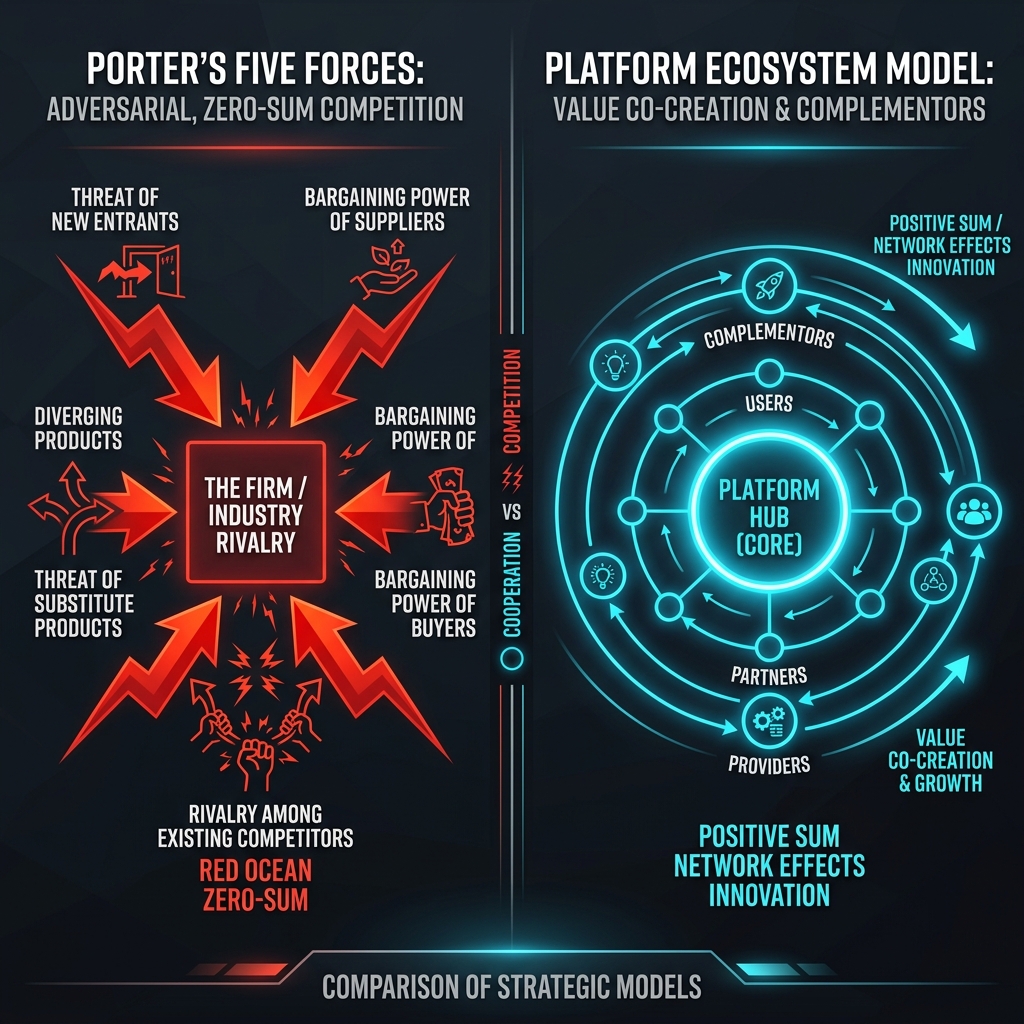
Under this framework, strategy is a defensive warfare. The goal is to build a fortress, squeeze your suppliers, lock in your buyers, and keep competitors at bay. If you are a handset manufacturer, developers are simply suppliers of software. Your job is to extract maximum value from them while paying them as little as possible.
This zero-sum mindset was the undoing of Nokia’s Symbian and Microsoft’s Windows Phone. They treated app developers as transactional contractors. They charged high developer fees, locked down APIs, and heavily controlled distribution. By treating developers as suppliers to be managed rather than partners to be empowered, they choked their own software supply lines.
2. The Sixth Force: The Complementor
The core academic criticism of Porter’s model is its omission of complementors (Grant & Jordan 2015). A complementor is a firm or individual whose product or service makes your product significantly more valuable when used together.
The classic textbook example is hardware and software, or hot dogs and hot dog buns. A hot dog bun maker is not your supplier (you don’t buy buns to make hot dogs) and not your competitor. Yet, if bun prices skyrocket or quality plummets, your hot dog sales will suffer. Conversely, if buns become cheap and widely available, your hot dogs become more attractive.
In the digital era, complementors are the primary driver of network effects:
- SaaS Platforms: Shopify is a great e-commerce tool, but its true moat is the Shopify App Store. The third-party developers building marketing plugins, subscription widgets, and inventory tools are complementors. They make Shopify infinitely adaptable, locking in merchants who cannot find that specific combination of tools elsewhere.
- API Infrastructure: Stripe’s payment gateway complements thousands of SaaS, marketplace, and creator platforms. Stripe does not build the marketplace; the marketplace developer does. By making payments plug-and-play, Stripe makes building a marketplace cheaper, which in turn drives more transactions through Stripe.
When you map an industry with complementors, the strategy shifts from conflict to co-creation (Kim & Mauborgne 2015). You want to make it as easy, cheap, and lucrative as possible for complementors to build on top of your product.
3. The Platform Pivot: Shifting the Demand Curve
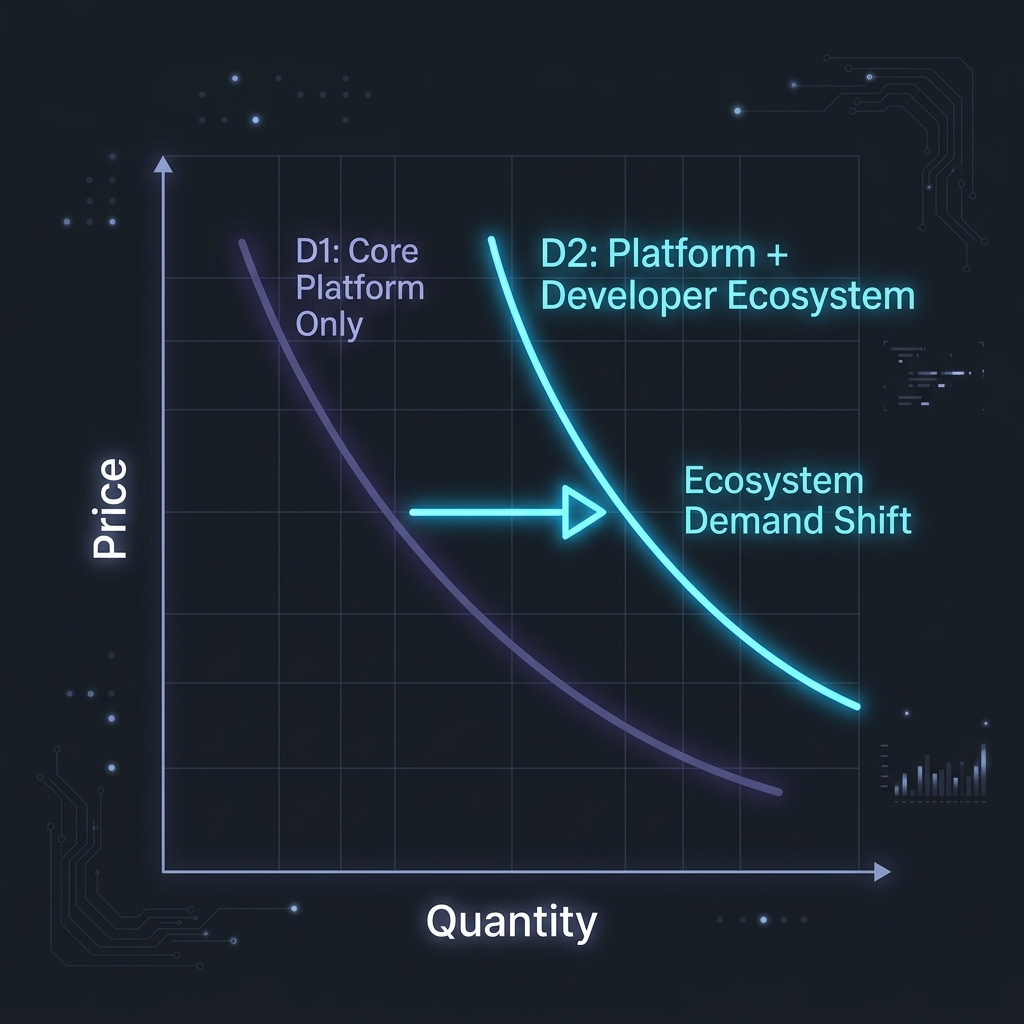
In economics, complementors have a direct, mathematical impact on the demand curve of the primary product.
When a customer evaluates a platform, they are not just buying the core software; they are buying the utility of the entire ecosystem. As the number of complementors (apps, integrations, APIs) increases, the customer’s willingness to pay for the core platform shifts outward.
This explains Google’s Android strategy:
- Low Barriers to Entry & Supply Shift: Google gave Android away for free to hardware makers, eliminating operating system licensing costs. In microeconomic terms, this reduction in input costs shifted the hardware providers’ supply curve to the right, increasing quantity supplied and lowering the retail price of smartphones (Goolsbee et al. 2020).
- Ecosystem Demand Shift: By encouraging an explosion of complementors (app developers) to populate the Google Play Store, Google shifted the demand curve for smartphones to the right, as the utility of the hardware grew with the ecosystem (Goolsbee et al. 2020).
- Ecosystem Moat: Once users owned Android phones with custom apps, purchased media, and familiar workflows, the switching costs (exit barriers) became massive. Google captured value not by selling the operating system, but by charging commissions on the Play Store and serving ads across the massive user base.
Nokia and BlackBerry, stuck in the traditional Five Forces mindset, could not understand how to compete with a free operating system because they did not understand that the operating system was no longer the product—the ecosystem was.
4. Engineering the Moat: Actionable Takeaways for Tech Leaders
If you are a developer, product manager, or technical director, understanding the role of complementors should directly influence how you design and build software.
I. Build API-First, Not Product-First
If your software lives in a silo, it is vulnerable to substitution. By designing your system API-first, you allow external systems to integrate with you easily. Every integration turns another company into a complementor. If their software relies on your API to function, they will fight to keep you in business.
II. Lower the Friction for Integration
A great API that is hard to use is a wasted resource. Provide clean documentation, SDKs in major languages, sandbox environments, and self-service portal access. The cheaper it is for a developer to integrate with your product, the more complementors you will attract. Shopify’s Liquid templating engine and clean API documentation were as critical to its business success as its core checkout code.
III. Share the Value Surplus
Do not try to extract every cent of profit from your ecosystem. If your developers cannot build profitable businesses on your platform, they will leave for a competitor who shares the wealth. Apple’s insistence on a rigid 30% App Store fee has created deep resentment and sparked legal challenges, opening the door for regulatory intervention and alternative web-based distribution. Sharing the surplus builds goodwill and aligns your ecosystem’s incentives with your own growth.
Conclusion: Expanding the Board
Michael Porter’s Five Forces remains a powerful tool for analyzing traditional, consolidated physical markets. But in the modern, interconnected software landscape, it is an incomplete map.
If you view business strategy solely as a zero-sum war against your competitors, suppliers, and customers, you will build closed, sterile systems. By expanding the board to include complementors, you can shift your strategy from defensive gatekeeping to collaborative growth. Think of it as playing a game of “Cyber Settlers”—where rather than blocking other players, your success is built on trading resources, forging routes, and developing shared settlements across a collaborative platform ecosystem (Teuber 1995). The most valuable software companies of the next decade will not be the ones that build the strongest walls, but the ones that build the most welcoming platforms.

References
- Goolsbee, A., Levitt, S. and Syverson, C. (2020) Microeconomics. 3rd ed. New York: Macmillan International.
- Grant, R. M. and Jordan, J. J. (2015) Foundations of Strategy. 2nd ed. Chichester: Wiley.
- Kim, W. C. and Mauborgne, R. A. (2015) Blue Ocean Strategy. Expanded ed. Boston: Harvard Business Publishing.
- Porter, M. E. (2004) Competitive Strategy: Techniques for Analyzing Industries and Competitors. Export ed. New York: Free Press.
- Teuber, K. (1995) Catan. Board Game. Stuttgart: Kosmos.
- Wu, J. (2023a) BU5048 Business Strategy. Lecture Notes, University of Aberdeen (26th September 2023).
- Wu, J. (2023b) BU5048 Business Strategy. Lecture Notes, University of Aberdeen (28th September 2023).