Black Swan on a Blue Ocean
In early 2020, the global travel industry faced an unprecedented catastrophic disruption. Within a matter of weeks, international borders closed, commercial flights were grounded, and booking volumes plummeted by over 90%. Traditional hotel conglomerates like Marriott, Hilton, and Hyatt—anchored by massive physical property portfolios, heavy real estate debt, and high fixed operating costs—faced severe liquidity crises and massive layoffs. Concurrently, Airbnb’s highly anticipated IPO was shelved, and the platform’s revenues dried up overnight. To industry commentators, the platform seemed just as vulnerable as its brick-and-mortar counterparts.
Yet, by December 2020, Airbnb went public at an $80 billion valuation, surpassing the combined market capitalization of its largest hotel competitors.
This dramatic divergence is a classic case study of how a firm survived a Black Swan—a highly improbable event with massive, unpredictable consequences (Taleb 2007). But Airbnb’s survival was not merely a stroke of luck; it was the result of a platform model that decoupled strategic exit barriers from asset ownership, and a dynamic capability to pivot strategy on the fly. As platforms face increasing regulatory and social pressures, however, their long-term survival depends on resolving the deep sustainability paradoxes built into their economic models.
1. The Strategy Spectrum: Mintzberg’s 5Ps on Platform Networks
Traditional strategic management often treats strategy as a static, pre-determined Plan or a defined market Position. However, Henry Mintzberg (1987) argued that strategy is a multidimensional construct, best understood through the 5Ps: Plan, Ploy, Pattern, Position, and Perspective.
- Plan: A consciously intended course of action.
- Ploy: A specific maneuver intended to outwit a competitor.
- Pattern: Consistency in behavior over time, whether intended or not.
- Position: Locating the organization in the competitive environment.
- Perspective: The organization’s fundamental worldview and culture.
When the 2020 pandemic struck, Airbnb’s initial Plan—to expand cross-border urban tourism—was rendered obsolete. However, its organizational Perspective (value orchestration through decentralized trust) and its market Position (a double-sided network of home-sharing) enabled a new, emergent Pattern of behavior to crystallize.
Traditional hotel groups view the market through a rigid Porter’s Five Forces value chain (Porter 2004). They treat suppliers (labor, food, laundry) as adversarial forces to be squeezed for cost leadership. In contrast, Airbnb’s platform model redefines hosts from adversarial suppliers into cooperative complementors (McIntyre & Srinivasan 2017). By shifting the strategic focus from asset ownership to ecosystem orchestration, Airbnb bypassed traditional industry rivalries and established a unique “Blue Ocean” position—an uncontested market space built on local, community-integrated stays rather than standardized hotel rooms (Kim & Mauborgne 2015).
2. The Sustainability Paradox: The Three Pillars in Platform Economics
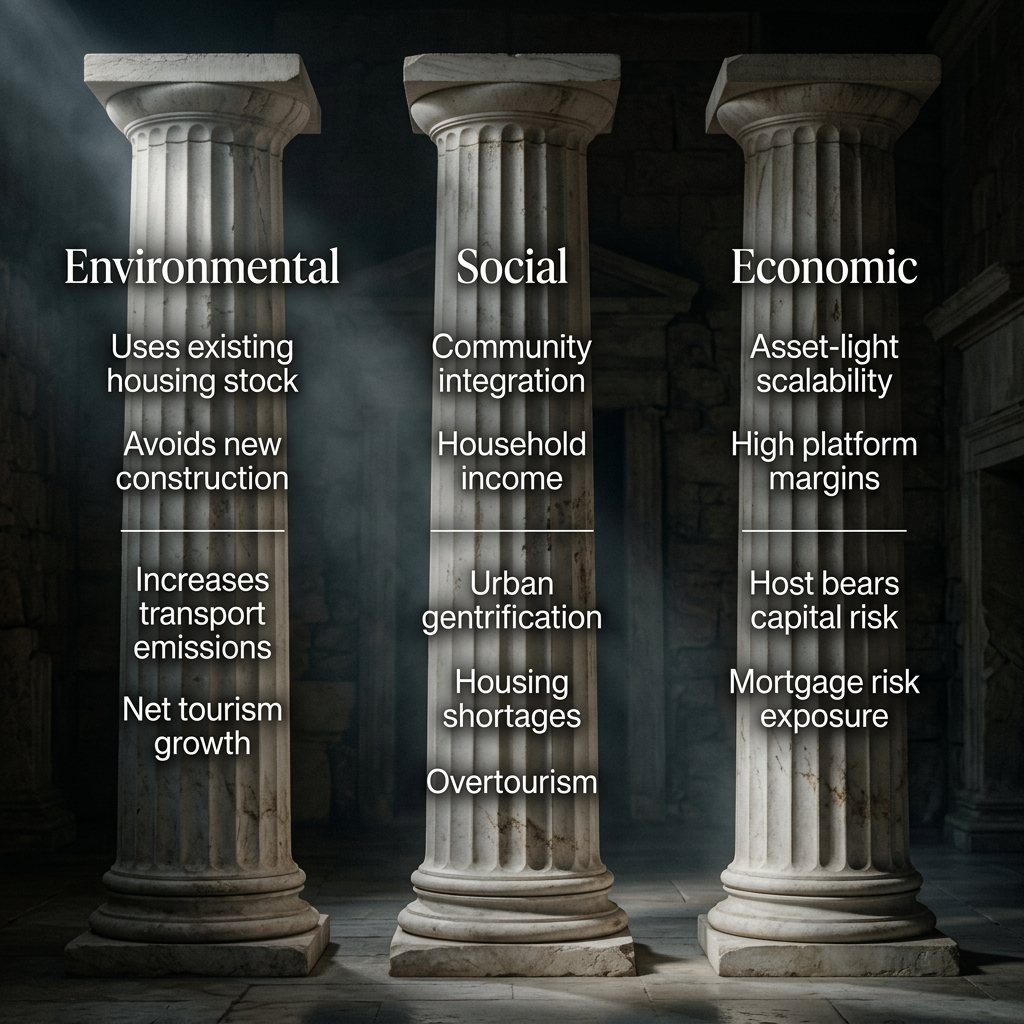
To evaluate the long-term viability of Airbnb’s Blue Ocean position, we must critically analyze it against the Three Pillars of Sustainability (Environmental, Social, and Economic):
Environmental Sustainability (Planet)
Airbnb represents a “green” business model transformation in terms of capital asset utilization. Building traditional hotels requires massive concrete and steel production, continuous industrial heating and laundry operations, and high energy usage. By using existing underutilized residential assets, Airbnb dramatically lowers the marginal environmental cost of adding lodging capacity.
Social Sustainability (People)
The platform’s greatest threat lies in the social pillar. By incentivizing landlords to switch from long-term residential leasing to short-term tourist rentals, Airbnb creates housing shortages and gentrification in historic urban centers (e.g., Amsterdam, Barcelona, Venice). This social displacement generates negative sentiment among residents, translating into aggressive municipal regulatory barriers (such as short-term rental bans, licensing caps, and zoning restrictions), which act as government-created entry barriers (Porter 2004).
Economic Sustainability (Profit & Risk)
Airbnb’s asset-light architecture is highly profitable but relies on a deep risk asymmetry. The platform captures transaction fees while shifting the capital and compliance risk entirely to the hosts. During the 2020 travel collapse, hosts were left holding empty properties and mortgages, revealing that platform economic sustainability often comes at the expense of its own supplier network.
3. Exit Barriers, Sunk Costs, and the Dynamic Pivot
When a market collapses, the cost of withdrawal is determined by its exit barriers (Porter 2004). Traditional hotel chains have exceptionally high exit barriers. Their real estate assets are illiquid, capital-intensive, and burdened by long-term debt. They cannot easily reconfigure their physical properties or shut down operations without incurring catastrophic sunk costs.
Airbnb, conversely, possesses low exit barriers due to its software-driven, asset-light architecture. The platform owns no real estate, meaning its operating costs are highly variable.
This structural flexibility is a prerequisite for Dynamic Capabilities—the firm’s ability to sense, seize, and transform its resources to adapt to rapidly changing environments (Teece et al. 1997). Airbnb’s pivot during the pandemic is a textbook demonstration of this capability:
- Sensing the Shift: In mid-2020, Airbnb’s product teams sensed a shift in consumer behavior. While international travel was dead, local staycations and remote workers seeking monthly rentals in rural areas were surging.
- Seizing the Opportunity: Rather than defending their urban listings, Airbnb seized this domestic demand. They pivoted their entire engineering and product focus within weeks.
- Transforming the Resource Base: Software developers re-engineered the platform’s search and recommendation algorithms. They modified database schemas to support open-ended dates and long-term bookings, redesigned the user interface to highlight destinations “nearby,” and launched a localized marketing campaign (“Go Near”).
Because their strategy was an agile Pattern supported by a flexible codebase, rather than a rigid physical Plan, Airbnb captured the domestic travel wave months before traditional hotel chains could adjust their physical supply lines.
4. Evolving the Sustainable Blue Ocean: Decentralized Wealth Building
For platform companies, the next strategic frontier is not merely achieving digital scale, but securing sustainable value innovation. To mitigate the gentrification backlash and local government crackdowns, Airbnb must evolve its market position from a standard platform into a Sustainable Blue Ocean.
We propose a new, sustainability-focused strategy: Decentralized Community Wealth Building.
Instead of continuing to concentrate listing density in hyper-touristy, residential urban centers (which drives up local rents and triggers regulatory bans), Airbnb can deploy its dynamic capability—its matching algorithms and trust API infrastructure—to actively redirect tourism traffic to under-visited, rural, and economically depressed regions.
Implementing the Strategy
- Algorithmic Redirection: Adjust the core recommendation and search ranking algorithms to systematically promote properties in designated “eco-tourism” or “community development” zones, using search discounting or fee waivers as a Ploy to nudge consumer behavior.
- Local Supplier Cooperatives: Partner with local agricultural and craft cooperatives in rural areas, integrating their services (guided tours, local food delivery) directly into the booking interface. This transforms the platform from a simple lodging broker into an ecosystem of local economic growth.
- Zoning Integration: Coordinate directly with regional authorities to align platform capacity with local environmental carrying capacities and housing requirements, turning the government from an adversarial barrier creator into a collaborative stakeholder.
This strategy addresses the three sustainability pillars simultaneously. Mathematically, it redistributes the economic benefits of tourism outward, lowering the social friction of gentrification, reducing overtourism pressures in major cities, and creating a new, uncontested lodging inventory (a Sustainable Blue Ocean) safe from urban regulatory threats.
Conclusion: Navigating the Improbable
The 2020 travel collapse proved that strategic survival in the modern era cannot rely on static market positioning or massive physical assets. In a volatile world, a rigid Plan backed by heavy capital commitments is a liability.
By understanding strategy as an emergent Pattern of adaptation, Airbnb transformed the threat of a Black Swan into a strategic milestone. By maintaining low exit barriers through a software-driven, asset-light architecture, and developing the dynamic capabilities to sense and seize consumer shifts in real time, they navigated an industry-wide collapse.
Yet, as platform networks mature, they cannot ignore their footprint on the physical world. The gentrification of urban neighborhoods, housing shortages, and the economic risk asymmetries of host networks are significant threats to their long-term viability. To survive the next Black Swan, platforms must look beyond mere transactional scale. They must align their technical agility with social and environmental sustainability, ensuring that their Blue Oceans remain resilient, collaborative, and sustainable ecosystems for both travelers and the communities they call home.
References
- Grant, R. M. and Jordan, J. J. (2015) Foundations of Strategy. 2nd ed. Chichester: Wiley.
- Kim, W. C. and Mauborgne, R. (2015) Blue Ocean Strategy. Expanded ed. Boston: Harvard Business School Press.
- McIntyre, D. P. and Srinivasan, A. (2017) “Networks, platforms, and strategy: Emerging views and next steps”. Strategic Management Journal, 38(1), pp. 141-160.
- Mintzberg, H. (1987) “The Strategy Concept I: Five Ps for Strategy”. California Management Review, 30(1), pp. 11-24.
- Porter, M. E. (2004) Competitive Strategy: Techniques for Analyzing Industries and Competitors. Export ed. New York: Free Press.
- Slack, N. and Brandon-Jones, A. (2021) Operations and Process Management. 6th ed. Harrow, England: Pearson.
- Taleb, N. N. (2007) The Black Swan: The Impact of the Highly Improbable. New York: Random House.
- Teece, D. J., Pisano, G. and Shuen, A. (1997) “Dynamic Capabilities and Strategic Management”. Strategic Management Journal, 18(7), pp. 509-533.